August 15, 2026
KAIROS on Escape: Our AI Animated Short in the Neo Cinema Spotlight
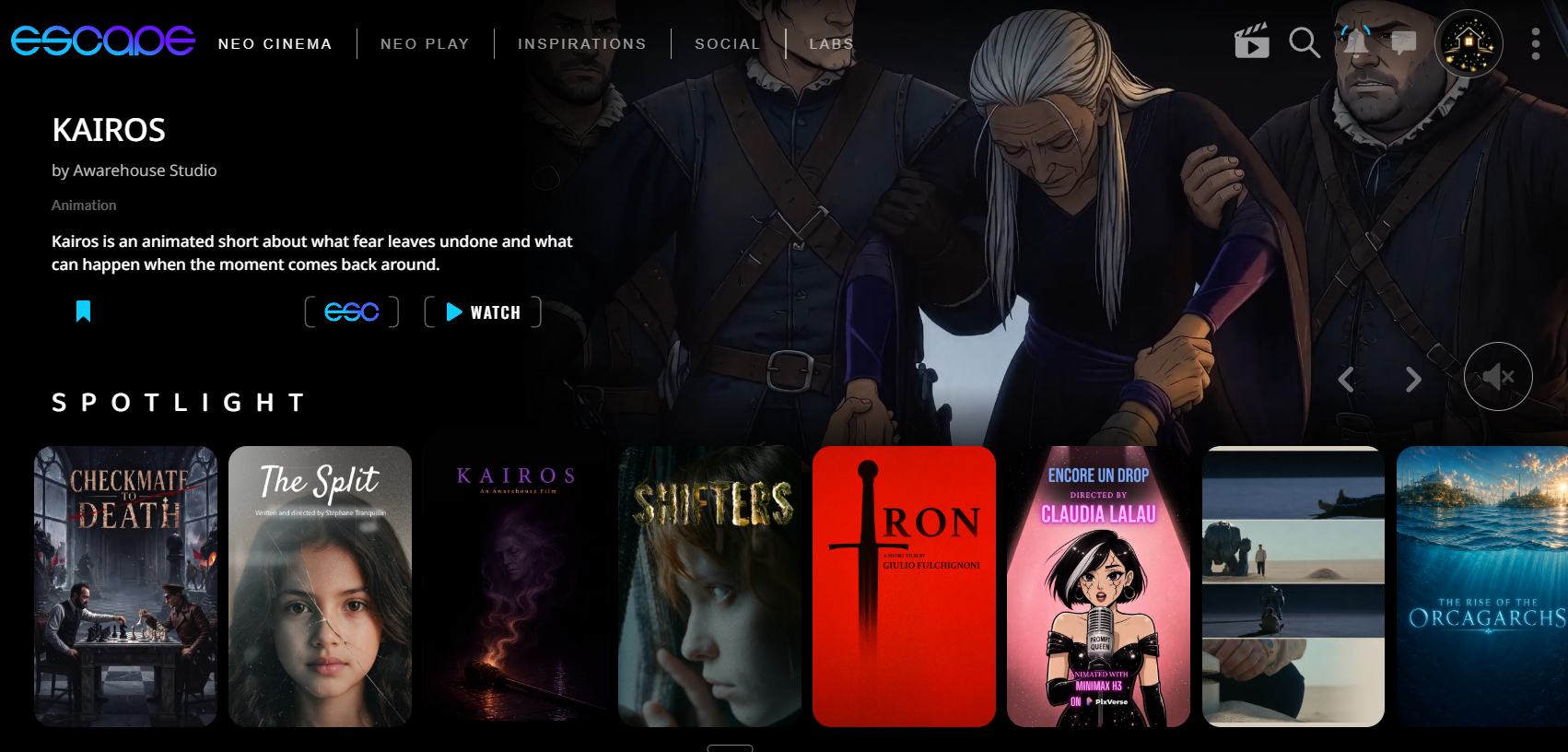
Why Escape AI matters to us
Escape is a streaming platform for what founder John Gaeta calls Neo Cinema. That means short films, series and animation made with generative AI next to traditional filmmaking craft. Gaeta is the Oscar-winning visual effects designer behind The Matrix and its bullet time. He prefers “Neo Cinema” to “AI cinema” because he sees it as cinema made possible by new tools, and as a way for independent creators to build original IP instead of serving franchises (GamesBeat).
The platform launched in beta in March 2025. It now carries more than 1,000 creator-led projects and has an app for Roku, Fire TV, Samsung and LG smart TVs (AR Insider). So AI film is moving off the timeline feed and into the living room.
That’s the shift we care about. We’ve been making films with AI for about three years, including two fully AI-generated series for SVT. Our question has never been can AI make images. It’s can it carry a story that stays with you. Being curated on a platform built around that question means a lot.
The film: one soul, two lifetimes, 343 years apart
The ancient Greeks had two words for time. Chronos is time that just passes. Kairos is the right moment, the opening that matters. KAIROS is a three-minute animated short about a soul that let its moment pass, and gets it back.
1677. Kali is a klok gumma, a Swedish cunning-woman and folk healer. Her village respected her until fear turned on her. She is one of the last victims of det stora oväsendet, “the Great Noise”, the witch panic that was already dying out. She dies in a madness that was ending. Before the men come, she ties a purple band around the wrist of Bruno, the man who loves her. “Don’t watch,” she tells him. “We are forever. Remember that.” At the pyre he wants to move, but he freezes.
2020. On the same patch of ground, John is 35 and hollow. He’s been running on empty for years and has no idea why. One night outside a bar called Embers he hears a scream from an alley. It’s the same moment, come round again. And he freezes again.
The heart of the film is the cut between the two. The woman on the ground and the woman at the stake. The man in the alley and the man at the pyre. What John does next is the story, so we’ll let the film tell you.
KAIROS explains nothing. There’s no talk of reincarnation, fate or magic. It shows two parallel events and trusts you to connect them. One purple band is the only thing that crosses the centuries. Underneath, the film makes a simple argument: love comes first, fear gets in the way, and courage is love in action.
Kairos is about what fear leaves undone, and what can happen when the moment comes back around.
How we made it: four weeks, one director, every frame AI-generated
Every image and moving shot in KAIROS was generated with AI. Then all of it was directed, composited and edited by hand. It took about four weeks from idea to finished film.
The story was talked into existence. It started as a skeleton: two timelines, a separation, a man who acts differently the second time. The director talked it through out loud on walks and recorded it. Claude worked as an interviewer, not a ghostwriter. Each recording came back as a summary, the open questions, the ideas he kept circling and what was still missing. Then he recorded again, until the story held.
Assets were locked first. We call our working principle circular, not linear: make it visible, make it work, make it good. The one exception is visual assets. Characters, locations and props go straight to final quality, because everything else is built on them. The look is our Neon Noir style: hand-inked graphic novel meets semi-realistic anime. 2020 is a rain-soaked night city in indigo and neon. 1677 is firelight against rock and storm-grey dusk. The execution site and the alley were designed on the same ground so the two moments could rhyme.
The animatic was made of moving video, not stills. We generated in 15-second clips, each holding about five shots, and alternated between generating and cutting. Every prompt led with character and action and ended with the style. The model weights the start of a prompt hardest, so the style arrives as a finish on top of a real shot.
The cut was directed from its turning points outward. The film was split into 13 sequences, each tracked as solid, open question, needs work or major redo. We screened it with prepared questions, such as when did you realise these are the same people? Then came a shot-by-shot polish pass: regenerating from upscaled frames, Photoshop rescues for tiny faces, and removing brand logos the models had slipped in.
Sound. The score is a family of related pieces: Stone Prayer, Stone Lament, Stone Breath, Stone Motif and Frozen Chapel. The rule was that music is fully committed or fully absent, never neutral. Sound design is by our own Anton Ariki Sten.
The toolchain:
| Stage | Tool |
|---|---|
| Story, shot list, prompts | Claude, Wispr Flow |
| Look, casting, locations | Grok Imagine |
| Character sheets, props, edits | GPT Image, Photoshop |
| Video | Seedance 2.0, Luma Ray 3 |
| Upscaling | Topaz |
| Edit | Premiere Pro |
| Score | Suno |
| Sound design | Anton Ariki Sten |
The tools will change by next year. The method won’t: build the story first and keep directing until the film expresses your vision.
What’s next
KAIROS is an Official Selection at the AI Movie Awards (AIMA) London, 7–8 November 2026, and we’ll be there in person. If you’re going, come say hi.
Until then, it’s three minutes long, and it’s waiting for you on Escape. Watch KAIROS on Escape →
Thank you to the Escape team for seeing it, and for connecting the dots.
— The Awarehouse Studio, Stockholm
— fin.
More stories